
Extending ScannerlessRDParser — hand-crafted parsers
For full control over the parse result type and error handling, subclass ScannerlessRDParser
directly and implement each production rule as a method.
Recommended pattern
Keep the constructor private and expose a static parse() entry point. This makes the
one-shot lifecycle explicit — the instance is created, used once, then discarded.
Note:
rdp-gengenerates this pattern automatically. If you are using the code generator, you getprivate constructorandstatic parse(input: string)for free.
import { ScannerlessRDParser } from '@configuredthings/rdp.js'

export class MyParser extends ScannerlessRDParser {
  private constructor(source: DataView) { super(source) }

  static parse(input: string): MyResult {
    const bytes = new TextEncoder().encode(input)
    return new MyParser(new DataView(bytes.buffer)).parse()
  }

  parse(): MyResult {
    // production rules here
  }
}Primitive operations
| Method | Description |
|---|---|
peek() | Returns the current byte, or null at end of input — does not consume |
consume() | Returns the current byte and advances one position |
advance() | Advances one position without returning the byte |
matchChar(b) | Advances and returns true if the current byte equals b; false otherwise |
expectChar(b, label) | Like matchChar but throws RDParserException on mismatch |
atEnd() | Returns true when all input has been consumed |
getPosition() | Returns the current byte offset |
restorePosition(pos) | Backtracks to a saved position (enables grammars beyond LL(1)) |
error(message) | Throws RDParserException with position information |
decodeSlice(start, end) | Decodes a UTF-8 slice of the source buffer as a string |
Worked example — arithmetic calculator
This parser evaluates arithmetic expressions, returning a number directly rather than a
parse tree. It implements the same grammar as the rdp-gen tutorial — see RDParserException for the exception type thrown on parse failure.
Expr   = wsp, Term, {wsp, ('+' | '-'), wsp, Term}, wsp;
Term   = Factor, {wsp, ('*' | '/'), wsp, Factor};
Factor = '(', Expr, ')' | Number;
Number = Digit, {Digit};
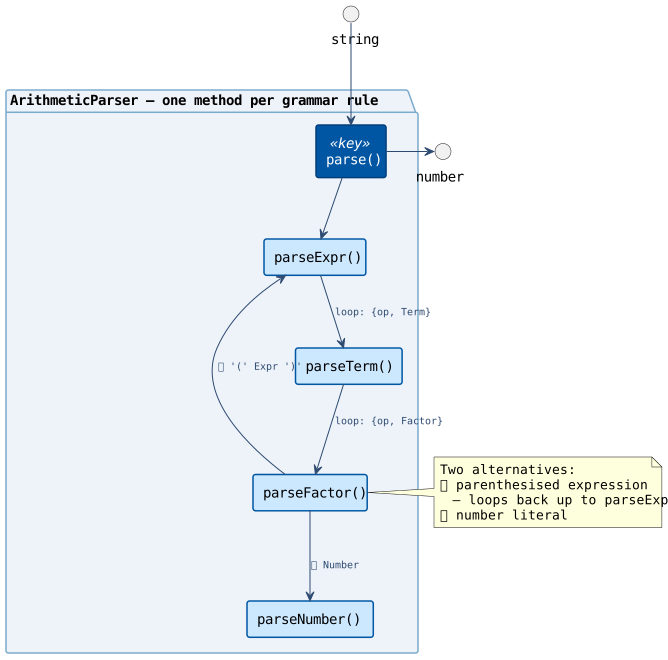
The call graph below shows how the methods relate. The loop-back from parseFactor to parseExpr is what handles parenthesised subexpressions — parsing (3 + 4) recurses all the way back to the top of the grammar and returns a value, which parseFactor then hands up the chain.
import { ScannerlessRDParser } from '@configuredthings/rdp.js'
import { RDParserException } from '@configuredthings/rdp.js'

export class ArithmeticParser extends ScannerlessRDParser {
  private constructor(source: DataView) { super(source) }

  static parse(input: string): number {
    const bytes = new TextEncoder().encode(input)
    return new ArithmeticParser(new DataView(bytes.buffer)).parse()
  }

  // Entry point — matches the full input
  parse(): number {
    this.skipWsp()
    const value = this.parseExpr()
    this.skipWsp()
    if (!this.atEnd()) this.error('unexpected input after expression')
    return value
  }

  // Expr = wsp, Term, {wsp, ('+' | '-'), wsp, Term}, wsp;
  private parseExpr(): number {
    let value = this.parseTerm()
    this.skipWsp()
    while (!this.atEnd()) {
      const op = this.peek()
      if (op !== 0x2b && op !== 0x2d) break   // '+' or '-'
      this.advance()
      this.skipWsp()
      const right = this.parseTerm()
      value = op === 0x2b ? value + right : value - right
      this.skipWsp()
    }
    return value
  }

  // Term = Factor, {wsp, ('*' | '/'), wsp, Factor};
  private parseTerm(): number {
    let value = this.parseFactor()
    this.skipWsp()
    while (!this.atEnd()) {
      const op = this.peek()
      if (op !== 0x2a && op !== 0x2f) break   // '*' or '/'
      this.advance()
      this.skipWsp()
      const right = this.parseFactor()
      value = op === 0x2a ? value * right : value / right
      this.skipWsp()
    }
    return value
  }

  // Factor = '(', Expr, ')' | Number;
  private parseFactor(): number {
    if (this.peek() === 0x28) {   // '('
      this.advance()
      this.skipWsp()
      const value = this.parseExpr()
      this.skipWsp()
      this.expectChar(0x29, "')'")
      return value
    }
    return this.parseNumber()
  }

  // Number = Digit, {Digit};
  private parseNumber(): number {
    if (!this.isDigit(this.peek())) this.error('expected a digit')
    let n = 0
    while (this.isDigit(this.peek())) {
      n = n * 10 + (this.consume() - 0x30)
    }
    return n
  }

  private skipWsp(): void {
    while (this.peek() === 0x20) this.advance()
  }

  private isDigit(b: number | null): b is number {
    return b !== null && b >= 0x30 && b <= 0x39
  }
}Usage:
ArithmeticParser.parse('42')              // → 42
ArithmeticParser.parse('3 + 4 * 2')      // → 11
ArithmeticParser.parse('(3 + 4) * 2')    // → 14
ArithmeticParser.parse('10 / (2 + 3)') // → 2Parsing fails with RDParserException:
import { RDParserException } from '@configuredthings/rdp.js'

try {
  ArithmeticParser.parse('??')
} catch (e) {
  if (e instanceof RDParserException) {
    console.error(e.message)   // "expected a digit (at position 0)"
  }
}