
Debugging with ObservableRDParser
ObservableRDParser adds opt-in parse tracing via a ParseObserver interface.
Attach one to receive a stream of enter/exit/error events for every production rule.
For generated parsers, pass the observer as the second argument to the static parse method.
For hand-written parsers that extend ObservableRDParser directly, call withObserver(obs)
on the instance before calling parse().
Production parsers extend the lean RDParser and carry zero observer overhead — only
parsers that explicitly extend ObservableRDParser incur any tracing cost.
Every production rule entry and exit fires a pair of events on the observer. The sequence below shows what fires when parsing the input "42" against the arithmetic grammar:
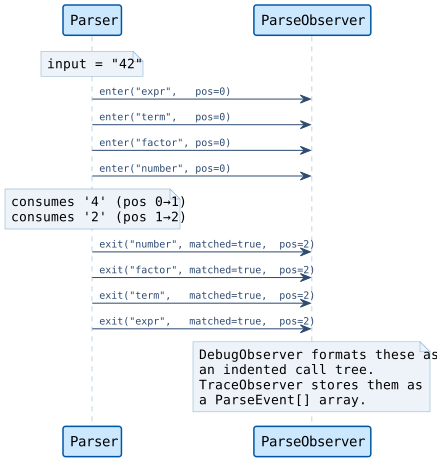
DebugObserver formats these as an indented call tree printed to the console. TraceObserver stores them as a ParseEvent[] array for programmatic inspection.
Generating an observable parser
Pass --observable to rdp-gen:
rdp-gen grammar.ebnf --parser-name MyParser --observable --output MyParser.tsThis changes the generated class to extend ObservableRDParser instead of ScannerlessRDParser, and
adds an optional observer?: ParseObserver second argument to the static parse method.
DebugObserver — indented call tree
DebugObserver formats parse events as an indented call tree and writes each line to a sink
(defaults to console.error):
import { MyParser } from './MyParser.js'
import { DebugObserver } from '@configuredthings/rdp.js/observable'

MyParser.parse('3 + 4', new DebugObserver())Example output for the arithmetic grammar parsing 3 + 4:
→ expr    pos:0
  → term  pos:0
    → factor  pos:0
      → number  pos:0
      ← number  matched  pos:1
    ← factor  matched  pos:1
  ← term  matched  pos:1
  → term  pos:4
    → factor  pos:4
      → number  pos:4
      ← number  matched  pos:5
    ← factor  matched  pos:5
  ← term  matched  pos:5
← expr    matched  pos:5
Redirect output to an array for assertions in tests:
const lines: string[] = []
MyParser.parse('3 + 4', new DebugObserver(line => lines.push(line)))TraceObserver — structured events
TraceObserver accumulates a full parse trace as an array of ParseEvent objects — useful
for programmatic inspection and testing:
import { TraceObserver } from '@configuredthings/rdp.js/observable'

const obs = new TraceObserver()
MyParser.parse('42', obs)

console.log(obs.events)
// [
//   { kind: 'enter', production: 'expr',   position: 0 },
//   { kind: 'enter', production: 'term',   position: 0 },
//   { kind: 'enter', production: 'number', position: 0 },
//   { kind: 'exit',  production: 'number', position: 2, matched: true },
//   { kind: 'exit',  production: 'term',   position: 2, matched: true },
//   { kind: 'exit',  production: 'expr',   position: 2, matched: true },
// ]Each event is one of:
type ParseEvent =
  | { kind: 'enter'; production: string; position: number }
  | { kind: 'exit';  production: string; position: number; matched: boolean }
| { kind: 'error'; message: string; position: number }Custom observer
Implement ParseObserver directly for bespoke tracing:
import type { ParseObserver } from '@configuredthings/rdp.js/observable'

class CountingObserver implements ParseObserver {
  readonly calls = new Map<string, number>()

  onEnterProduction(production: string): void {
    this.calls.set(production, (this.calls.get(production) ?? 0) + 1)
  }
  onExitProduction(): void {}
  onError(): void {}
}

const obs = new CountingObserver()
MyParser.parse('3 + 4', obs)
console.log(obs.calls)
// Map { 'expr' => 1, 'term' => 2, 'factor' => 2, 'number' => 2, 'wsp' => 5 }Adding observer support to a TokenRDParser subclass
ObservableRDParser is a concrete subclass of ScannerlessRDParser — it can't be used
directly as a base for token-stream parsers. Use the withObservable() mixin instead,
which applies observer support to any RDParser subclass:
import { TokenRDParser } from '@configuredthings/rdp.js'
import { withObservable } from '@configuredthings/rdp.js/observable'
import type { ParseObserver } from '@configuredthings/rdp.js/observable'

class MyTokenParser extends withObservable(TokenRDParser) {
  static parse(input: string, observer?: ParseObserver) {
    const stream = classify(input, spanTokenize(input))
    const parser = new MyTokenParser(stream)
    if (observer) parser.withObserver(observer)
    return parser.parse()
  }
  // ... #parseRule() stubs
}The mixin adds withObserver(obs), notifyEnter(), and notifyExit() — call
notifyEnter/notifyExit in each parse method to emit events, exactly as
--observable does in generated scannerless parsers.
Using GrammarInterpreter with an observer
GrammarInterpreter extends ObservableRDParser, so you can attach any observer to it
for step-by-step grammar debugging without a code-generation step:
import { GrammarInterpreter } from '@configuredthings/rdp.js/interpreter'
import { EBNFParser }          from '@configuredthings/rdp.js/generator'
import { TraceObserver }       from '@configuredthings/rdp.js/observable'

const ast = EBNFParser.parse(`
  Number = Digit, {Digit};
  Digit  = '0' | '1' | '2' | '3' | '4' | '5' | '6' | '7' | '8' | '9';
`)

const obs = new TraceObserver()
const bytes = new TextEncoder().encode('42')
new GrammarInterpreter(ast, new DataView(bytes.buffer))
  .withObserver(obs)
  .parse()

console.log(obs.events)